LIBRO (1991).
MARTÍN SÁNCHEZ, Miguel Ángel: Miguel el Arcángel de Dios en Canarias:
Aspectos socio- culturales y artísticos. Prólogo de Víctor Nieto Alcaide.
Ed. Aula de Cultura del Excmo. Cabildo Insular de Tenerife, Publicaciones
Científicas, en la colección Arte e Historia, núm. 19, Santa Cruz de Tenerife, 1991.
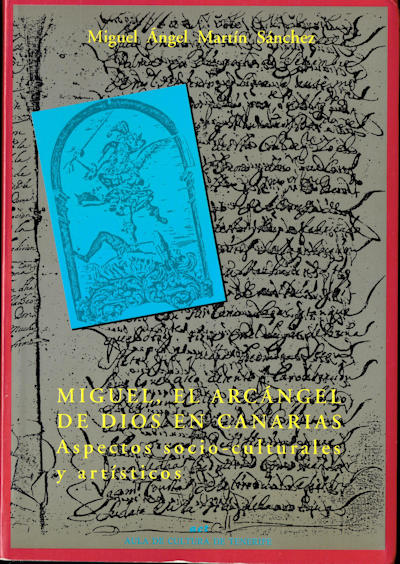 Trata sobre culto e iconografía de San Miguel en Canarias desde la Conquista hasta nuestros días. Contiene una síntesis de un amplio material extraído de otras investigaciones que han sentado bases y establecido hipótesis para un ámbito amplísimo: Oriente y Occidente. En el norte y centro de Europa han proliferado estudios sobre los prototipos culturales precursores del San Miguel cristiano. Ven en Miguel el sustituto de divinidades de la mitología clásica, gala o germánica. La riqueza de ese amplio abanico de posibilidades incita a no aventurarse por el camino de las conclusiones generales, en tanto que investigaciones más sistemáticas no hayan arrojado datos fehacientes sobre los transvases de un culto a otro, de una a otra cultura. Este punto de partida se confronta con aspectos de carácter histórico, aportados por cronistas e historiadores canarios.
Se estructura en 5 partes:
1ª. San Miguel y la guerra. El guerrero invencible se asocia a la conquista militar. Su culto se reactiva en periodos de crisis y cambios profundos. En Canarias, región tardíamente convertida al cristianismo, La Palma se pone bajo su advocación para conseguir la victoria militar definitiva. En Tenerife se instrumentaliza para la aniquilación de focos de resistencia indígena. Dará nombre a fortalezas defensivas y, más tarde, en Fuerteventura, aparece otorgando una victoria a sus habitantes frente a invasores ingleses.
2ª. San Miguel y el poder. Su poder se incuba en su nombre QVIS SICVT DEVS. Tras la Conquista, se le dedican varias capillas y colonos flamencos -cultivadores y exportadores de azúcar- las enriquecen con obras de Flandes: san Miguel, símbolo de poder frente a los operarios. Ingresa en escudos heráldicos. Se usurpa su carácter religioso y el Arcángel actúa como exorcismo propiciatorio a través del cual se pretende conseguir la preeminencia del poder político-religioso sobre una población en proceso de colonización.
3ª. San Miguel y el triunfo. Arcángel contrarreformista. La lucha de Miguel con el Dragón se relaciona con antecedentes míticos sujetos al concepto filosófico del Bien frente al Mal. El modelo combativo se dinamiza. El Barroco convierte a Miguel en referente de la iglesia de Roma frente a la Reforma y en imagen del triunfo de la Fe. En Canarias aparecen modelos de reposado triunfalismo y de arrebatado triunfalismo.
4ª. San Miguel y la muerte. La angustia ante la muerte. De creencias no occidentales el Arcángel asume la función de acompañante de los muertos. Con la inquietud en torno al Juicio Final la figura de Miguel crece como pesador de almas. Su aparición en los textos bíblicos va aparejada con una brillante carrera en los apócrifos, donde asume una nueva faceta: conductor de almas. Se le dedican capillas y cementerios. En Canarias existen bastantes obras sobre las Ánimas del Purgatorio, pero aquí Miguel no pesa las acciones morales del difunto sino las oraciones, responsos y misas que los vivos han sufragado a favor del alma en pena.
5ª. San Miguel y la vida. La naturaleza sobrenatural otorga un cariz espiritual y aéreo. En la Edad Media se le dedican lugares en alto (Mont-Saint-Michel) donde el peregrino establece un dialogo espiritual, de carácter ascensional. Arcángel hidrópata, forma parte de un ritual propiciatorio de la salud. En Gran Canaria existía un enclave de peregrinación donde se buscaba entrar en contacto con su agua santificadora. En La Palma su culto se plantea en la conjunción de milicia celestial-milicia terrenal. Su procesión en La Laguna se entiende como una afirmación del Triunfo de la Fe y de la Victoria sobre una población ganada para la Corona de Castilla y el orbe cristiano.
El libro acaba con un catálogo de obras de san Miguel en las islas, índice topográfico, índice de oráculos, apéndice de documentos y textos fundamentales para la mejor comprensión de la iconografía de san Miguel en Canarias y, por último, una bibliografía comentada.
Texto completo

Citas recibidas

It deals with the cult and iconography of San Miguel in the Canary Islands from the Conquest to the present day. It contains a synthesis of extensive material extracted from other research that has laid foundations and established hypotheses for a very broad area: East and West. In northern and central Europe, studies have proliferated on the precursor cultural prototypes of the Christian San Miguel. They see in Miguel the substitute for divinities from classical, Gallic or Germanic mythology. The richness of this wide range of possibilities encourages us not to venture down the path of general conclusions, as long as more systematic research has not provided reliable data on the transfers from one cult to another, from one culture to another. This starting point is confronted with aspects of a historical nature, contributed by Canarian chroniclers and historians.
It is structured in 5 parts:
1st. San Miguel y la guerra. (Saint Michael and the war.) The invincible warrior is associated with military conquest. His cult is reactivated in periods of crisis and profound changes. In the Canary Islands, a region that converted late to Christianity, La Palma placed itself under his patronage to achieve the definitive military victory. In Tenerife it is used to annihilate centers of indigenous resistance. It will give its name to defensive fortresses and, later, in Fuerteventura, it appears granting a victory to its inhabitants against English invaders.
2nd. San Miguel y el poder. (Saint Michael and power.) His power is incubated in his name QVIS SICVT DEVS. After the Conquest, several chapels were dedicated to him and Flemish settlers - sugar growers and exporters - enriched them with works from Flanders: Saint Michael, a symbol of power over the workers. Enter heraldic shields. Its religious character is usurped and the Archangel acts as a propitiatory exorcism through which it is intended to achieve the pre-eminence of political-religious power over a population in the process of colonization.
3rd. San Miguel y el triunfo. (Saint Michael and the triumph.) Counter-reformation archangel. Miguel's fight with the Dragon is related to mythical antecedents subject to the philosophical concept of Good versus Evil. The combative model is energized. The Baroque makes Miguel a reference for the church of Rome in the face of the Reformation and an image of the triumph of Faith. In the Canary Islands, models of calm triumphalism and rapturous triumphalism appear.
4th. San Miguel y la muerte. (Saint Michael and death.) The anguish in the face of death. From non-Western beliefs, the Archangel assumes the function of companion of the dead. With the concern around the Final Judgment, the figure of Miguel grows as a weigher of souls. His appearance in the biblical texts is accompanied by a brilliant career in the Apocrypha, where he assumes a new facet: conductor of souls. Chapels and cemeteries are dedicated to him. In the Canary Islands there are quite a few works about the Ánimas del Purgatorio (Souls in Purgatory), but here Miguel does not weigh the moral actions of the deceased but rather the prayers, responses and masses that the living have borne in favor of the soul in pain
5th. San Miguel y la vida. (Saint Michael and life.) The supernatural nature gives a spiritual and aerial aspect. In the Middle Ages, high places (Mont-Saint-Michel) were dedicated to him where the pilgrim established a spiritual dialogue, of an ascensional nature. Hydropathic Archangel, is part of a propitiatory health ritual. In Gran Canaria there was a pilgrimage enclave where people sought to come into contact with its sanctifying water. In La Palma his cult is raised in the conjunction of heavenly militia-earthly militia. Its procession in La Laguna is understood as an affirmation of the Triumph of Faith and Victory over a population won for the Crown of Castile and the Christian world.
The book ends with a catalog of works of Saint Michael in the islands, a topographical index, an index of oracles, an appendix of documents and fundamental texts for a better understanding of the iconography of Saint Michael in the Canary Islands and, finally, an annotated bibliography.

Das Werk befasst sich mit dem Kult und der Ikonographie des Heiligen Michael auf den Kanarischen Inseln von der Eroberung bis in die Gegenwart. Es enthält eine Zusammenfassung umfangreicher Materialien aus anderen Forschungsarbeiten, die Grundlagen geschaffen und Hypothesen für einen äusserst weiten Bereich aufgestellt haben: den Orient und den Okzident. In Nord- und Mitteleuropa sind zahlreiche Studien über die kulturellen Vorläufer des christlichen Heiligen Michael erschienen. Sie sehen in Michael den Ersatz für Gottheiten der klassischen, gallischen oder germanischen Mythologie. Die Vielfalt dieser breiten Palette an Möglichkeiten legt nahe, sich nicht auf allgemeine Schlussfolgerungen einzulassen, solange systematischere Untersuchungen keine verlässlichen Daten über die Übertragungen von einem Kult auf den anderen, von einer Kultur zur anderen, geliefert haben. Dieser Ausgangspunkt wird mit historischen Aspekten konfrontiert, die von kanarischen Chronisten und Historikern beigesteuert wurden.
Er gliedert sich in fünf Teile:
1. Der Heilige Michael und der Krieg. Der unbesiegbare Krieger wird mit militärischen Eroberungen in Verbindung gebracht. Sein Kult erlebt in Zeiten von Krisen und tiefgreifenden Veränderungen eine Wiederbelebung. Auf den Kanarischen Inseln, einer Region, die erst spät zum Christentum konvertierte, wurde La Palma unter seinen Schutz gestellt, um den endgültigen militärischen Sieg zu erringen. Auf Teneriffa wird er zur Auslöschung indigener Widerstandsnester instrumentalisiert. Er gibt Verteidigungsfestungen ihren Namen, und später erscheint er auf Fuerteventura, um den Einwohnern einen Sieg über englische Angreifer zu bescheren.
2. Der Heilige Michael und die Macht. Seine Macht liegt in seinem Namen QVIS SICVT DEVS verborgen. Nach der Eroberung wurden ihm mehrere Kapellen gewidmet, und flämische Siedler – Zuckerbauern und -exporteure – schmückten diese mit Kunstwerken aus Flandern: der Heilige Michael, Symbol der Macht gegenüber den Arbeitern. Er wird auf Wappen dargestellt. Sein religiöser Charakter wird vereinnahmt, und der Erzengel fungiert als versöhnender Exorzismus, durch den die Vorherrschaft der politisch-religiösen Macht über eine im Kolonisierungsprozess befindliche Bevölkerung angestrebt wird.
3. Der Heilige Michael und der Triumph. Der Erzengel der Gegenreformation. Der Kampf des Michael gegen den Drachen steht im Zusammenhang mit mythischen Vorläufern, die dem philosophischen Konzept des Guten im Kampf gegen das Böse unterliegen. Das kämpferische Motiv gewinnt an Dynamik. Das Barock macht Michael zu einem Symbol der römischen Kirche im Kampf gegen die Reformation und zum Inbegriff des Triumphs des Glaubens. Auf den Kanaren finden sich Darstellungen sowohl von zurückhaltendem als auch von überschwänglichem Triumphalismus.
4. Der Heilige Michael und der Tod. Die Angst vor dem Tod. Aus nicht-westlichen Glaubensvorstellungen übernimmt der Erzengel die Rolle des Begleiters der Verstorbenen. Angesichts der Besorgnis um das Jüngste Gericht gewinnt die Figur des Michael als Seelenwäger an Bedeutung. Sein Auftreten in den biblischen Texten geht einher mit einer glänzenden Karriere in den Apokryphen, wo er eine neue Facette annimmt: die des Seelenführers. Ihm werden Kapellen und Friedhöfe gewidmet. Auf den Kanarischen Inseln gibt es zahlreiche Werke über die Seelen im Fegefeuer, doch hier wägt Michael nicht die moralischen Taten des Verstorbenen ab, sondern die Gebete, Responsorien und Messen, die die Lebenden zugunsten der leidenden Seele dargebracht haben.
5. Der Heilige Michael und das Leben. Das Übernatürliche verleiht ihm einen spirituellen und ätherischen Charakter. Im Mittelalter wurden ihm hochgelegene Orte gewidmet (Mont-Saint-Michel), an denen der Pilger einen spirituellen, aufstiegsorientierten Dialog führte. Als «Wasserheilender» Erzengel ist er Teil eines Rituals zur Förderung der Gesundheit. Auf Gran Canaria gab es einen Wallfahrtsort, an dem man den Kontakt zu seinem heilsamen Wasser suchte. Auf La Palma versteht sich sein Kult als Verbindung zwischen himmlischer und irdischer Streitmacht. Seine Prozession in La Laguna wird als Bekräftigung des Triumphs des Glaubens und des Sieges über ein Volk verstanden, das für die Krone von Kastilien und die christliche Welt gewonnen wurde.
Das Buch schliesst mit einem Verzeichnis der Werke des Heiligen Michael auf den Inseln, einem topografischen Index, einem Index der Orakel, einem Anhang mit Dokumenten und grundlegenden Texten zum besseren Verständnis der Ikonografie des Heiligen Michael auf den Kanaren sowie schliesslich einer kommentierten Bibliografie.